
Lundi 13 mai à 14h30 en salle 3035
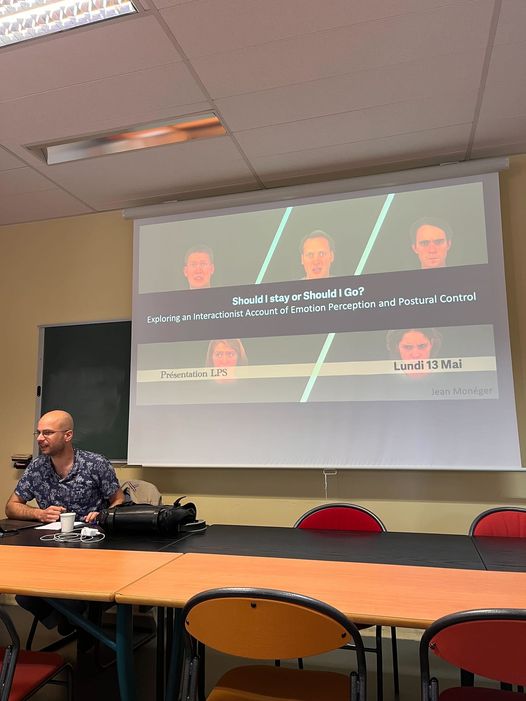
Résumé :
Emotional facial expressions serve a communicative purpose, indicating behavioural intentions to others. Such social cues could prompt approach or avoidance of the perceived faces. However, the literature reports mixed findings with emotional expressions such as anger or fear being associated with both approach and avoidance. In this study (N = 151 participants), we investigated how facial characteristics (i.e., gaze direction) and individual traits (Big Five and Schizotypal personality) modulate behavioural responses to the perception of neutral, angry, fearful, and sad faces. We assessed approach and avoidance using force plates to investigate spontaneous backward and forward postural adjustments. Results show that angry and fearful faces elicit defensive responses characterized by backward body sway (i.e., avoidance). Although facial features further qualified those defensive reactions with deviated gazes in fear stimuli eliciting approach, we did not find conclusive evidence for the role of personality in these responses. We discuss the relevance of force plates in assessing spontaneous responses to social cues and suggest a framework for understanding emotional expression processing.
À lire aussi

Projet TIBERPAF : Tolérance et Reconnaissance des Afrodescendants en France
2025 – 2026 | AAP BRIO Université Paris Cité | Projet TIBERPAF : Tolérance et Reconnaissance des Afrodescendants en France (ANR-21-EXES-0002, StratExExcellencES-2025-006). Octavia Ionescu (Université Paris Cité / LPS) et Maylis Samba (Université Paris Cité / LPS) À...

Projet SOCART: Investigating the Social Psychology of Critical Cartography.
2025 – 2026 | Global Engagement Partnership Fund King’s College London | Projet SOCART: Investigating the Social Psychology of Critical Cartography. Aurélien Graton (Université Paris Cité / LPS), Octavia Ionescu (Université Paris Cité / LPS) et Mike Duggan (King’s...

Projet FEELD : Affective Fields for Human Navigation
2026 – 2029 | ANR AAPG 2026 | Projet FEELD : Affective Fields for Human Navigation (ANR-26-CE28-6061). Christophe Blaison (coordinateur, Université Paris Cité / LPS), Morgan Beaurenaut (Université Paris Nanterre / LICAE), Pascale Piolino (Université Paris Cité /...

Projet TabEx : Fumer pour s’affilier ? Comprendre l’effet de l’Exclusion sociale sur la consommation de Tabac des lycéens
2026 - 2029 | IReSP-INCa_AA P-CAD-2026 | Projet TabEx : Fumer pour s’affilier ? Comprendre l’effet de l’Exclusion sociale sur la consommation de Tabac des lycéens (CAD-V126-009) | 249 000 euros | 36 mois Marie-Pierre Fayant (coordinatrice, Université Paris Cité /...